Archive for the 'love & hate' Category

h1

Batman: Black and White

July 9th, 2009 Posted by Esther Inglis-Arkell

Lately DC has been adding an eight-page back-up story featuring a new character to existing comic books.

The Question has been appearing as a back-up to Detective Comics, and the Blue Beetle has been added to Booster Gold.  I love the double feature, both because it gives me a chance to get to know new characters and because it allows ongoing stories of characters who, for reasons that pass understanding, don’t sell well enough on their own.

And now that I’ve pushed some minor characters, let’s get back to the five-hundred pound gorilla; Batman.  This is a guy who’s passed around to any title that needs a boost, from The Outsiders to the Blue Beetle.  (Tough beat on that last one, Battsy.  We all felt it.)

But what would be a different way to present Batman, considering he’s already in at least five books at a time?  I don’t know.  But I know what I want, and that is a return of the Batman: Black and White series.

Batman: Black and White, pitched by Mark Chiarello, was a series of 8-page Batman stories written and drawn by different artists.  The stories ran singly at the end of the newly-created Batman: Gotham Knights, and as 4-story collections.  The art and the writing are superb, the stories wildly disparate, running the gamut from gothic horror, to poetic meditation, to cutsy bat-with-a-baby stories.  There is a story in which Batman frees a genetically-engineered mermaid.  There is one in which Batman threatens someone’s life for killing his son’s cat.  There is one in which Batman is futuristic freedom fighter, and one in which he and an early Catwoman/Batgirl mash-up fight nazis, and one where he bleeds in an alley.

The stories are collected into three volumes, all of which are well-worth getting.  They are a must-have to any fan, partly because of the talent involved, but mainly because they add up to more than the sum of their parts.  The many takes on Batman, his motivations and his effects, his different eras and his absurdities, end up building something far more epic and sweeping than any planned Batman story I’ve ever read.  If I wanted to argue that superhero comics can be moving and artistic, these are the books I would present as evidence.

And if something like that were to come back, I would clamor for people to read it, no matter what book it was stuck to.

Post to Twitter Post to Delicious Post to Digg Post to Facebook Post to Reddit Post to StumbleUpon

Related posts

h1

Mary, Mary, Quite Contrary

June 23rd, 2009 Posted by david brothers

I’m a little surprised at how much of my taste in comics has its origins in Daredevil. I got back into comics largely through buying copies of Frank Miller’s Daredevil Visionaries. I’d never read his run on Daredevil, and it was just what I needed to leapfrog onto the Bendis run, which led to other Marvel books, and so on. When I was a kid, Miller was my introduction to both grown-up comics and crime comics.
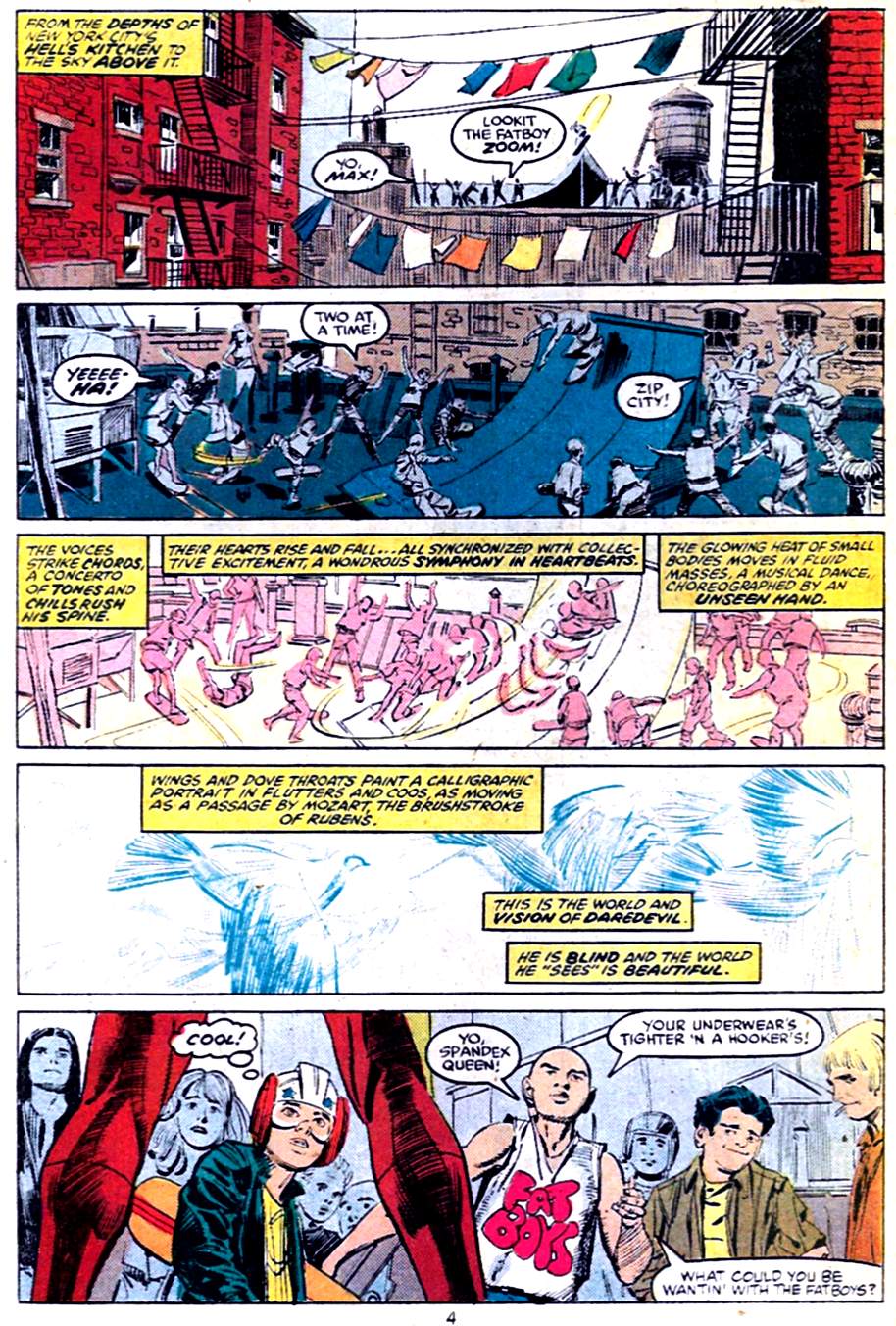
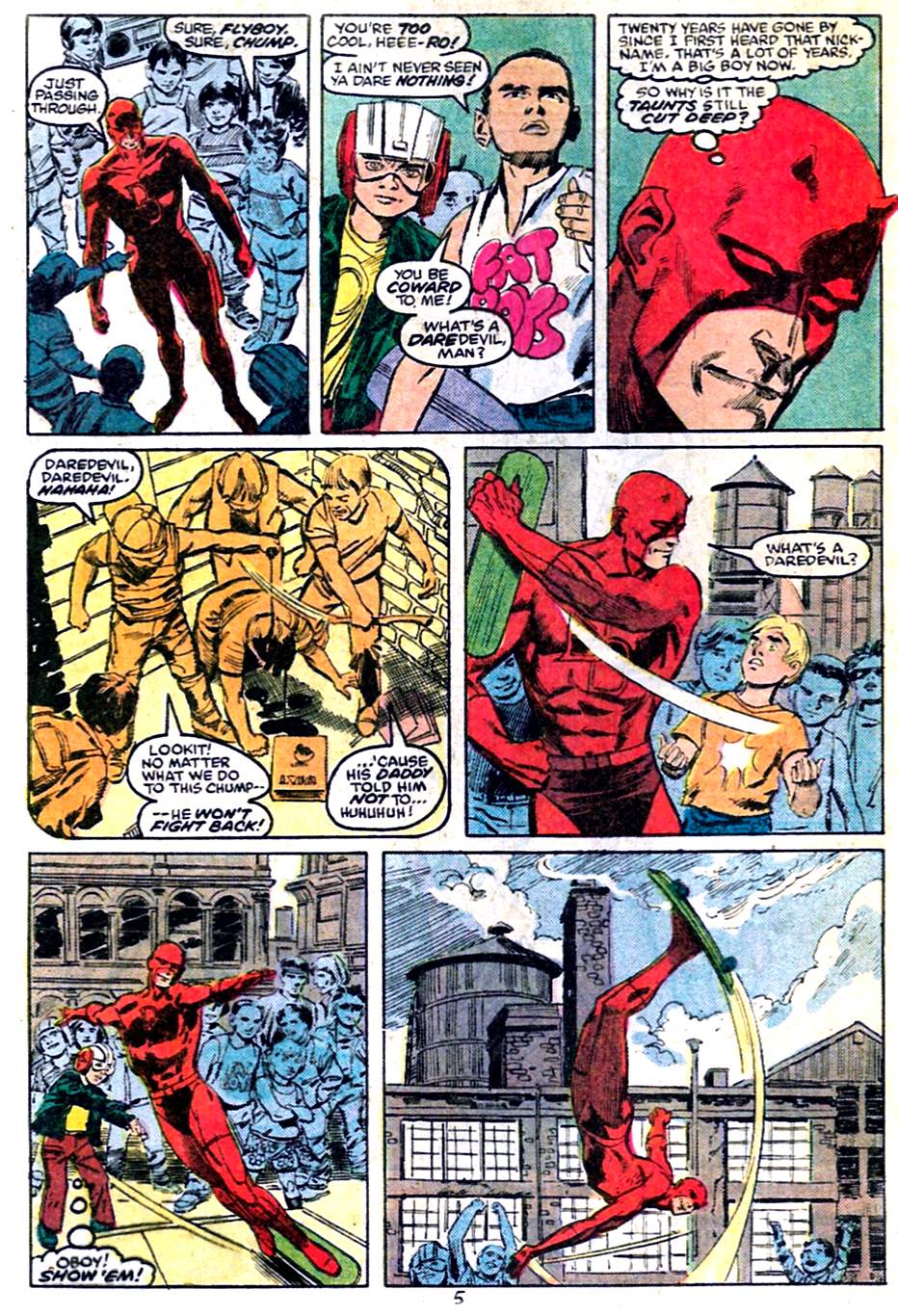
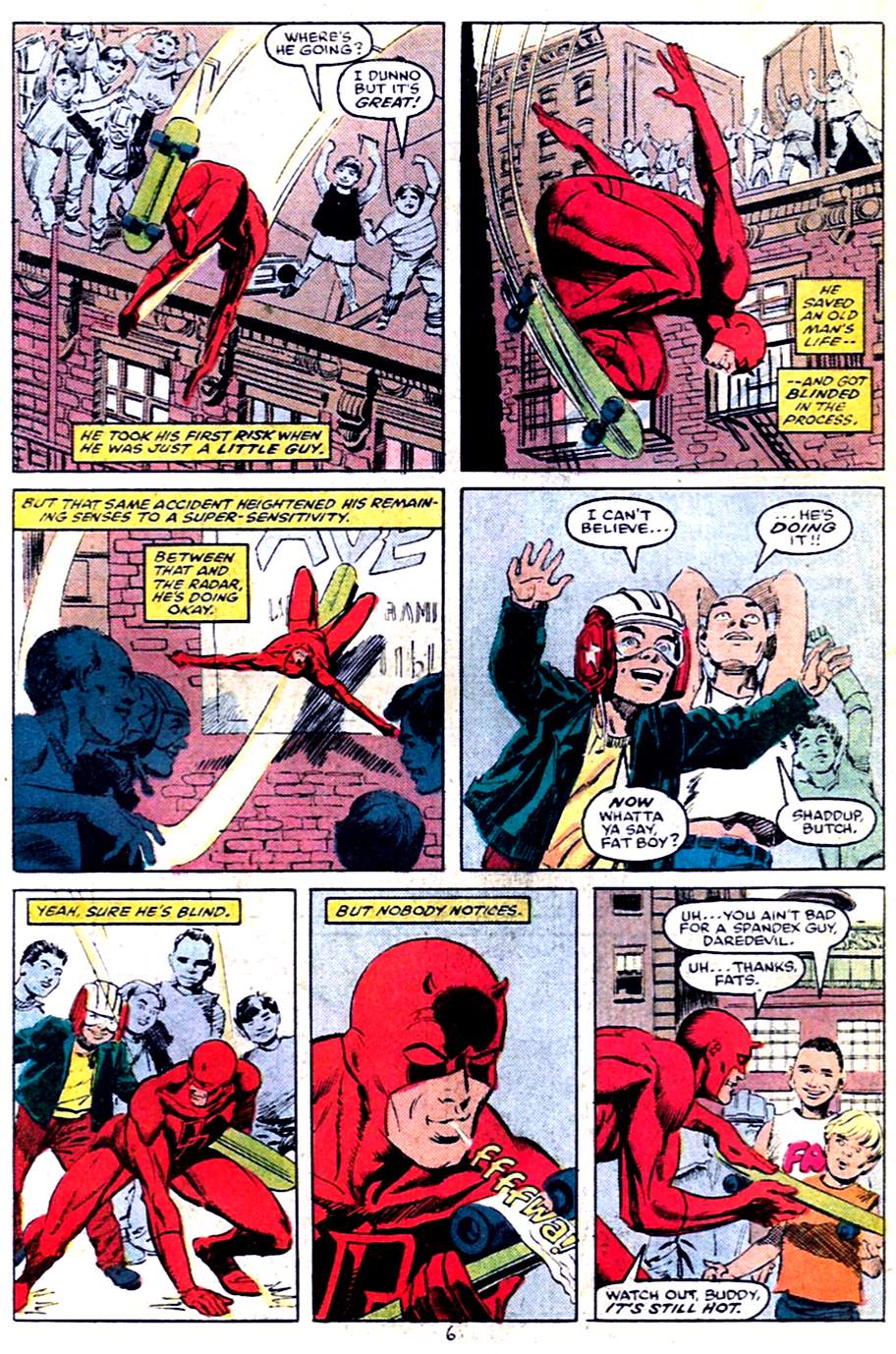
There’s another aspect to this that I haven’t talked about, before. Before I was introduced to Grant Morrison’s work, before I discovered Joe Casey, Ann Nocenti introduced me to weird comics in the pages of Daredevil. I didn’t have many issues of her run, but I had some of the ones with Typhoid Mary and a few seriously off-kilter tales.

daredevil239p04daredevil239p05daredevil239p06

I’ve been re-reading Nocenti’s run on Daredevil, and it positively leans. Her run is as much about how Daredevil is an overly violent fascist and a failure of a hero as it is about swashbuckling and dating. Nocenti got right up in the face of what it meant to pull on tights and beat up a criminal and did a pretty good job of breaking it down into its component parts. She has Murdock struggle with the thought of solving problems with his fists, forcing him to look at the effect he has on his environment. She introduced the Fatboys, a gang of youths who alternate between assisting Daredevil and getting into trouble. They follow his example and sometimes they get hurt. Sometimes they hurt people.

What’s so amazing about Nocenti’s run is that she followed up Frank Miller and David Mazzuchelli’s Born Again, one of the top five best superhero stories. Picking up the reins after two masters of the game told an amazing story must’ve been daunting, but Nocenti handled it well. She picked up the storylines they left, continuing on with a law practice-less, but happy, Murdock.

Brubaker and Bendis’s Daredevil is inextricably linked to the Frank Miller version. They’re continuing on in the same kind of story that he started back in the day. Nocenti, though, swerved right out of the gate. Her Murdock flipflops from confident to troubled, wrestling with his demons with the help of his girlfriend.

Typhoid Mary, whose origin story is collected in Daredevil Legends Vol. 4: Typhoid Mary, has been one of my favorite villains since I was a kid. Obviously, I didn’t get the Madonna (Mary)/Whore (Typhoid) complex that helps define her character or the subtle (?) feminism that Nocenti slipped in. There was just something about her that was, and is, endlessly interesting to me. She wasn’t like Batman’s villains, who were just crazy for the sake of being crazy. She wasn’t like Spider-Man’s villains, either, who were concerned with wealth. I don’t know that I had the mental capacity as a kid to articulate why I enjoyed reading about her so much. Mary was just undeniable.
The best word for her, as near as I can tell, is “uncomfortable.” Lesser writers will treat her as a generic crazy chick, Poison Ivy Plus Catwoman Minus Clothes. Nocenti, though, used her like a scalpel. She wasn’t a Bad Girl, but she was a bad girl. Typhoid Mary was a lot of issues distilled into one creature– religion, sexism, feminism, violence, and morality collided in her. She’s genuinely damaged goods, and troubling.

Mary is the easiest thing to point to when describing Nocenti’s run on Daredevil, but it’s just a part of the whole. There was the nuclear holocaust-obsessed son of a supervillain, the trials of the Fatboys, and the Inferno crossover. It’s creepy, but not creepy like a horror comic or a T&A book. It’s a crawling creepy, a book that makes you feel uneasy. Heroes who are far from perfect and entirely too human, a city full of people who refuse to be categorized into neat little boxes, the way a homeless woman tries to tell her husband where her gift is before she’s murdered by a villain… “that’s not right” sums it up pretty well.

Nocenti’s one of my favorite writers. No wishy-washy “one of my favorite female writers” or “throwback writers” or whatever. Just straight up, real talk, “favorite writers.” She’s good at what she does, and well worth seeking out. She’s spent the past few years out of comics, including filming a documentary, but she’s got a story in Daredevil 500 this August, with art by David Aja.

Good on her and good on Marvel for seeking her out. I’d like to see more work out of her in the future. I miss her voice in comics. Marvel should reprint more of her Daredevil. She did something special, and I think she’s been unfairly overshadowed by Miller’s run. Both are classic for different reasons.

Post to Twitter Post to Delicious Post to Digg Post to Facebook Post to Reddit Post to StumbleUpon

Related posts

h1

“Reruns of Your Grief”

June 12th, 2009 Posted by david brothers

Geoff Johns and Ethan van Sciver’s Flash: Rebirth #3 explains Barry Allen’s bowtie (again), features a race between Flash and Superman (Flash wins, because the other races were for charity), and the return of a Flash villain (surprise!). It’s bringing a very Silver Age character into a modern context, resulting in the kind of story that Barry hasn’t really appeared in before, to my knowledge. It’s kind of like Green Lantern: Rebirth, which was the revitalization and redemption of a Silver Age icon whose time had passed some years before. The new Supergirl is the old Supergirl, the new Kid Flash used to be the Flash, and Green Lantern is doing a story that springs from, what, eight pages from twenty years ago?

And I’m bored.

I’m not on the “DC sucks, Marvel rules!” tip, because a lot of Marvel books are boring me in a different way than most of DC’s current output. I’ll read a book if an interesting team is on it, obviously, and I buy a gang of Vertigo. But, when I think of what I’m least interested in currently, DC is the first thing on my lips.

It was the Flash/Superman race in Flash: Rebirth. I’m a Flash fan. It’s obvious, and I’ve written about my love for certain stories featuring character before. At the same time… the race was just another in a long line of nods at a time that was over before I was born. That’s the only reason it existed. It’s like a Family Guy joke– “do you remember when?” I don’t know what it added to the story except “Barry is a jerk now” and “Superman is slower than the Flash.” The bowtie thing– I don’t get it. Who cares about his bowtie? Is this something I’m missing? Does it hold some special significance, other than a woman he just met gave it to him, and he later married her?

No, it’s another “remember when?”

Answer: Yes.

“Interested yet?”

Answer: No. I’m tired of watching reruns.

Post to Twitter Post to Delicious Post to Digg Post to Facebook Post to Reddit Post to StumbleUpon

Related posts

h1

Pluto: Kids’ Comics for Grownups

May 29th, 2009 Posted by david brothers

In a just world, Pluto: Urasawa x Tezuka would be a game changer.

For the past twenty or thirty years, Marvel and DC have made a business out of telling mature stories with characters that were originally aimed at kids. While they have had some runaway successes, the majority of their output has been less than quality. The characters began growing older, going through increasingly extreme trials and tribulations, and rapidly speeding away from anything resembling “appropriate for all ages.”

In Pluto, Naoki Urasawa does it right. I recently finished the first three volumes He avoids the sensationalism and grime that tends to accumulate around stories that reinvent kiddie characters for an adult audience. I can’t judge its faithfulness to Osamu Tezuka’s “The Greatest Robot on Earth.” I’ve never read that story, and probably won’t until I finish Pluto. However, as a story in and of itself, Pluto is excellent.

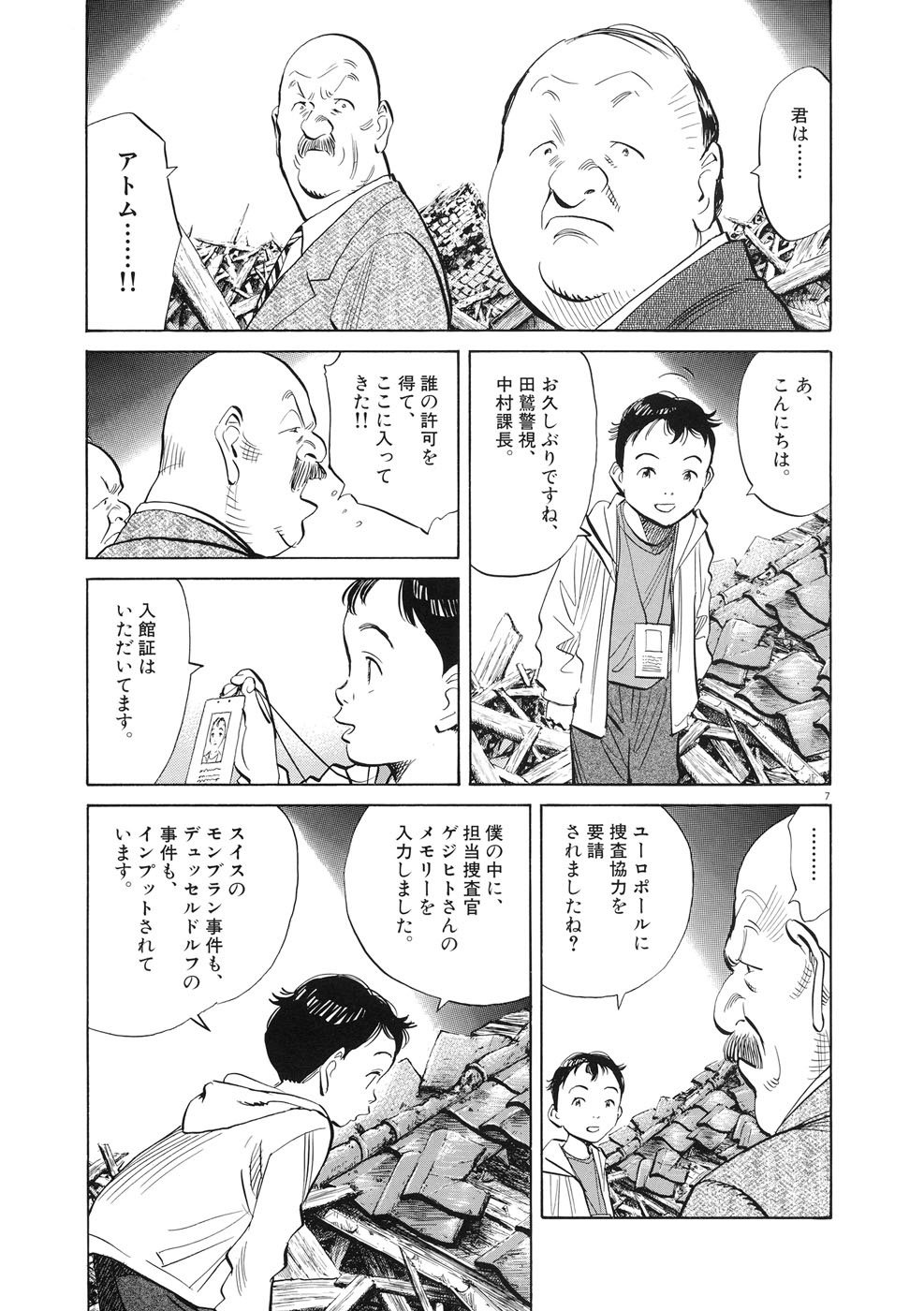
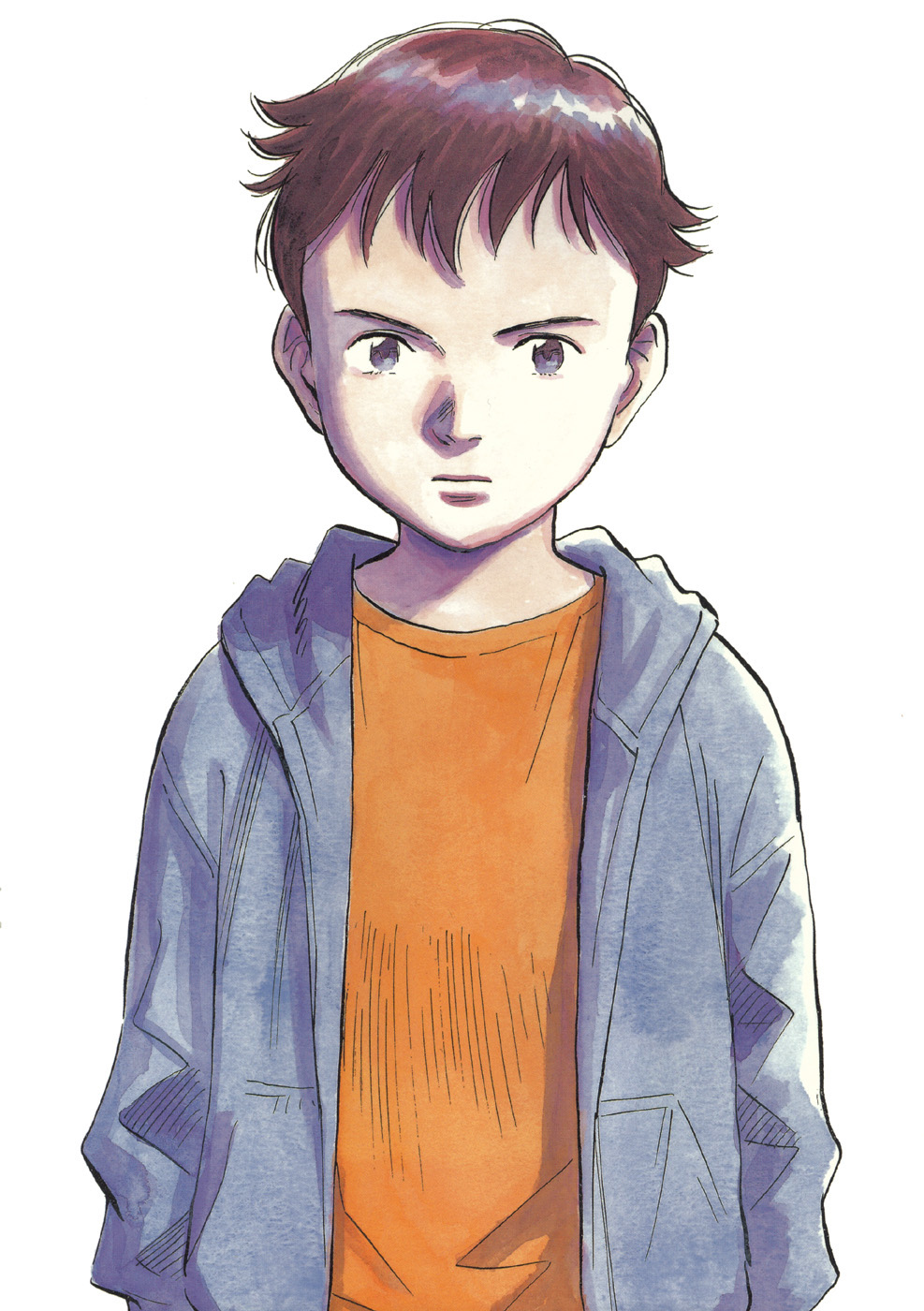
pluto-atomPluto is, essentially, a re-telling that shifts the focus of the original story. My understanding of the original work is that it was an Astro Boy story that featured several guest stars. As of volume 3 of Pluto, Urasawa has elevated Gesicht, a detective, to the same position as Astro Boy in the original work, while Atom and another character serve as something between supporting characters and lead protagonists.

You could say that the story is about Gesicht and his search for a serial killer, but that would be selling it short. It is about Gesicht, Atom, Atom’s sister Uran, and various other characters. The serial killer, whose identity isn’t truly revealed until the end of book three, simply serves as a convenient way to move these characters into situations where they have to interact with and bounce off each other.

I’m very fond of the relationship that Atom and Gesicht have. The inversion of the traditional “wise old man” works very well. Gesicht comes across as child-like next to the more technologically (and emotionally) advanced Atom. He’s full of questions and conjecture, and eager to pick Atom’s brain. He comes across almost rude in his probing, but he’s coming from a good place.

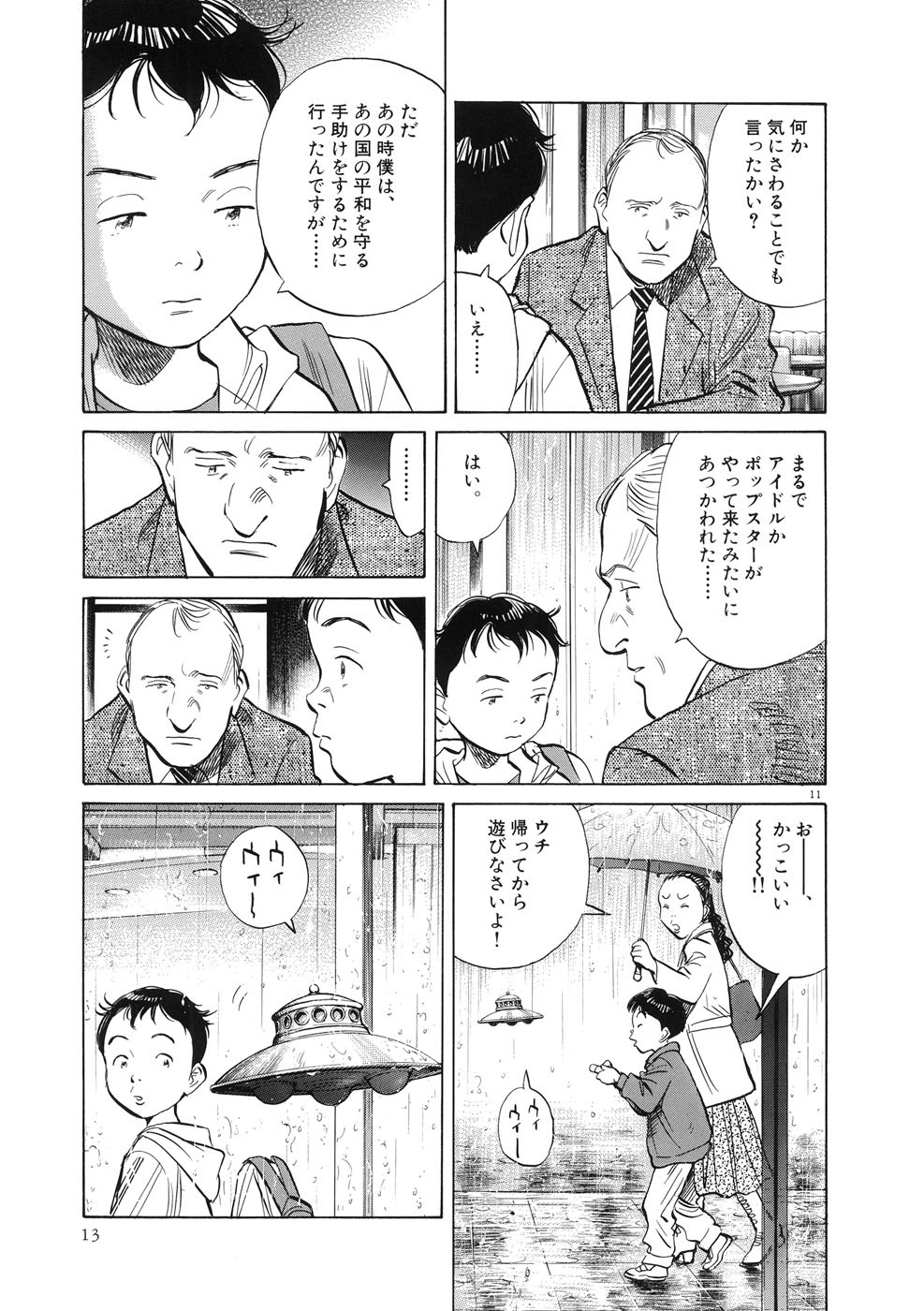
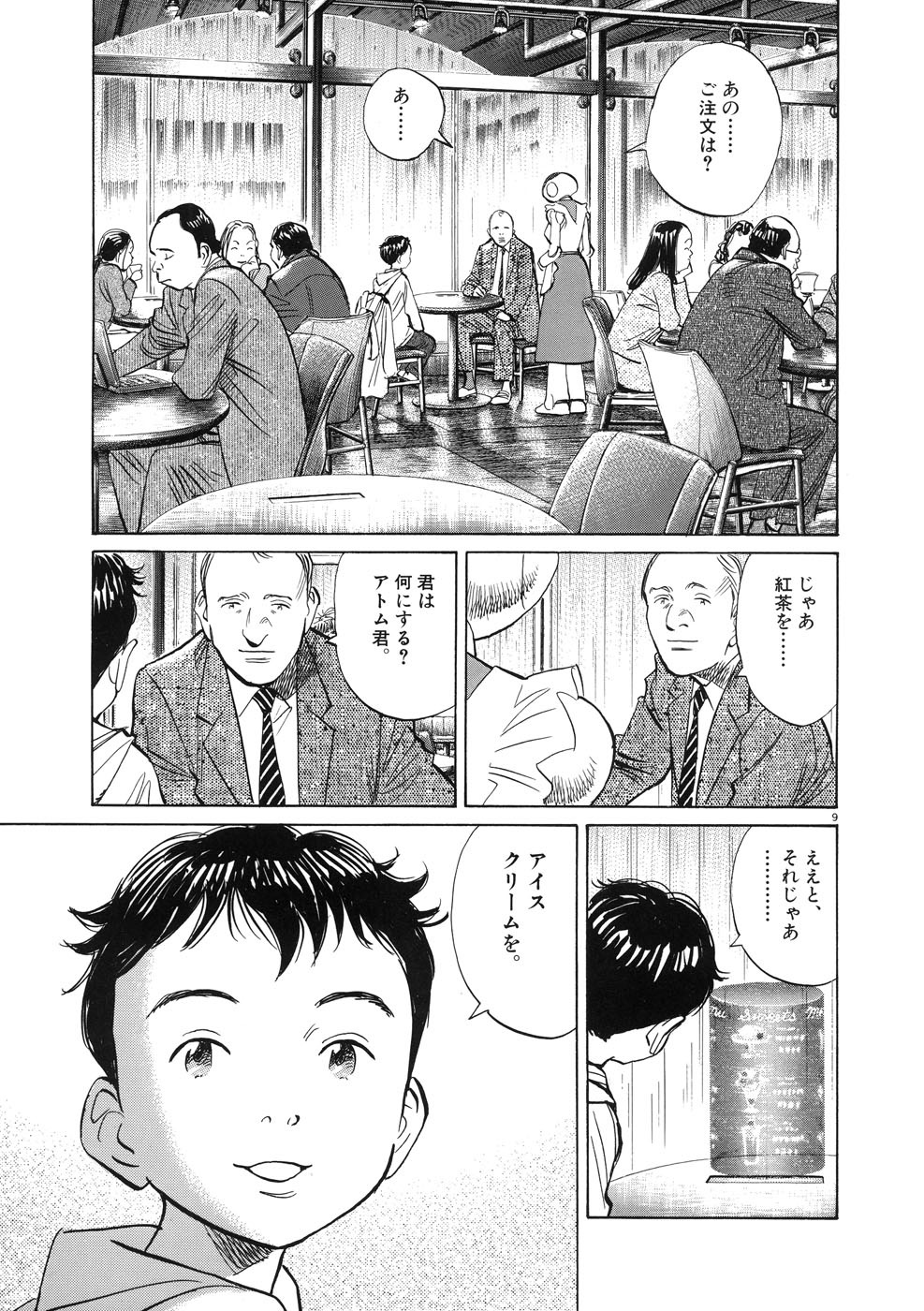
pluto-atomfaces-01Atom, on the other hand, is impossibly self-assured and confident. He knows his abilities well, and is content with his life. His “real boy” demeanor never comes off as false or forced. When he sees a floating UFO and get distracted, or when he digs into a bowl of ice cream, he genuinely enjoys it. Boiling him down to something as simple as a robot is doing him an injustice, because he is clearly so much more. Just the fact that the first thing he orders is ice cream is telling.

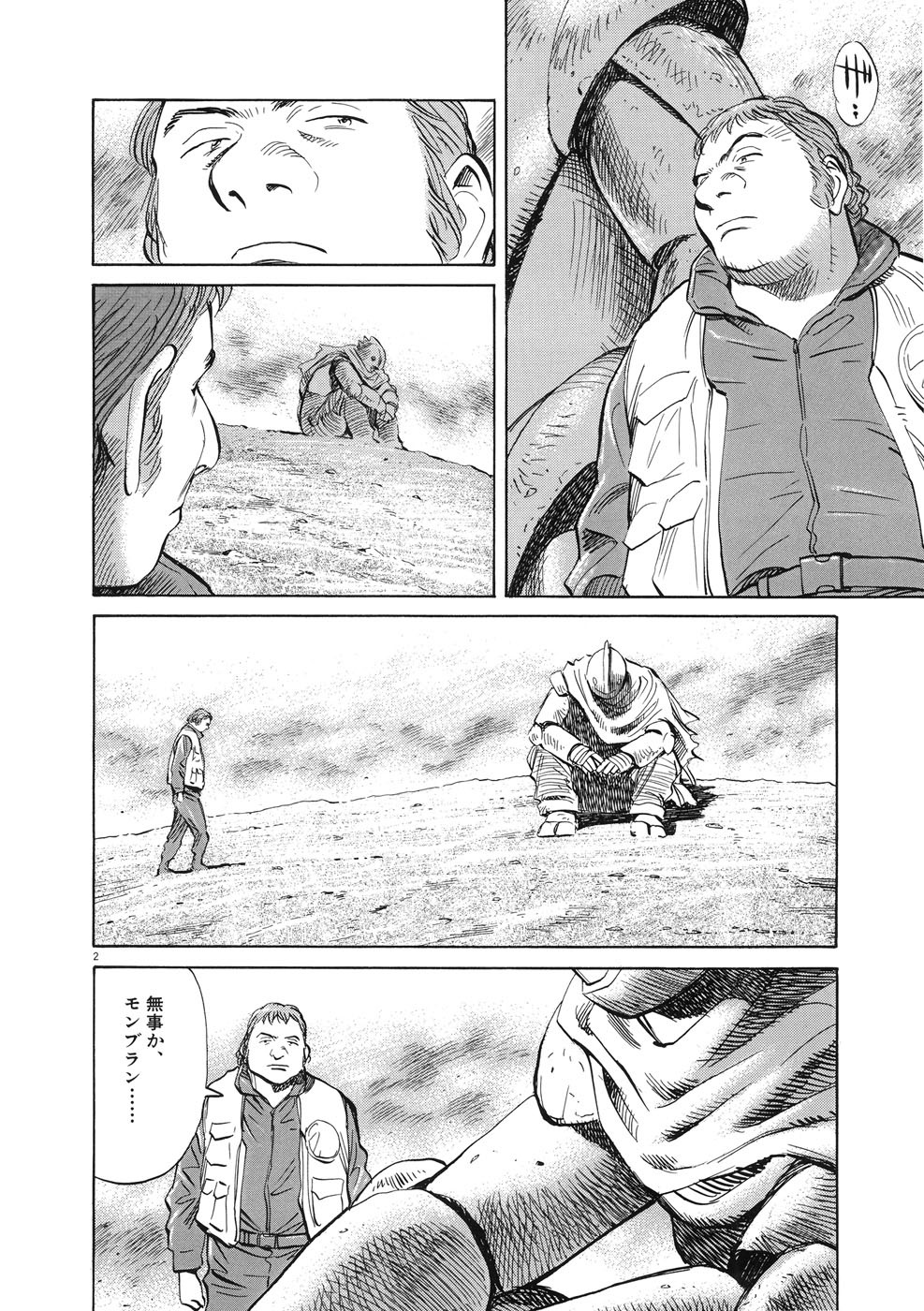
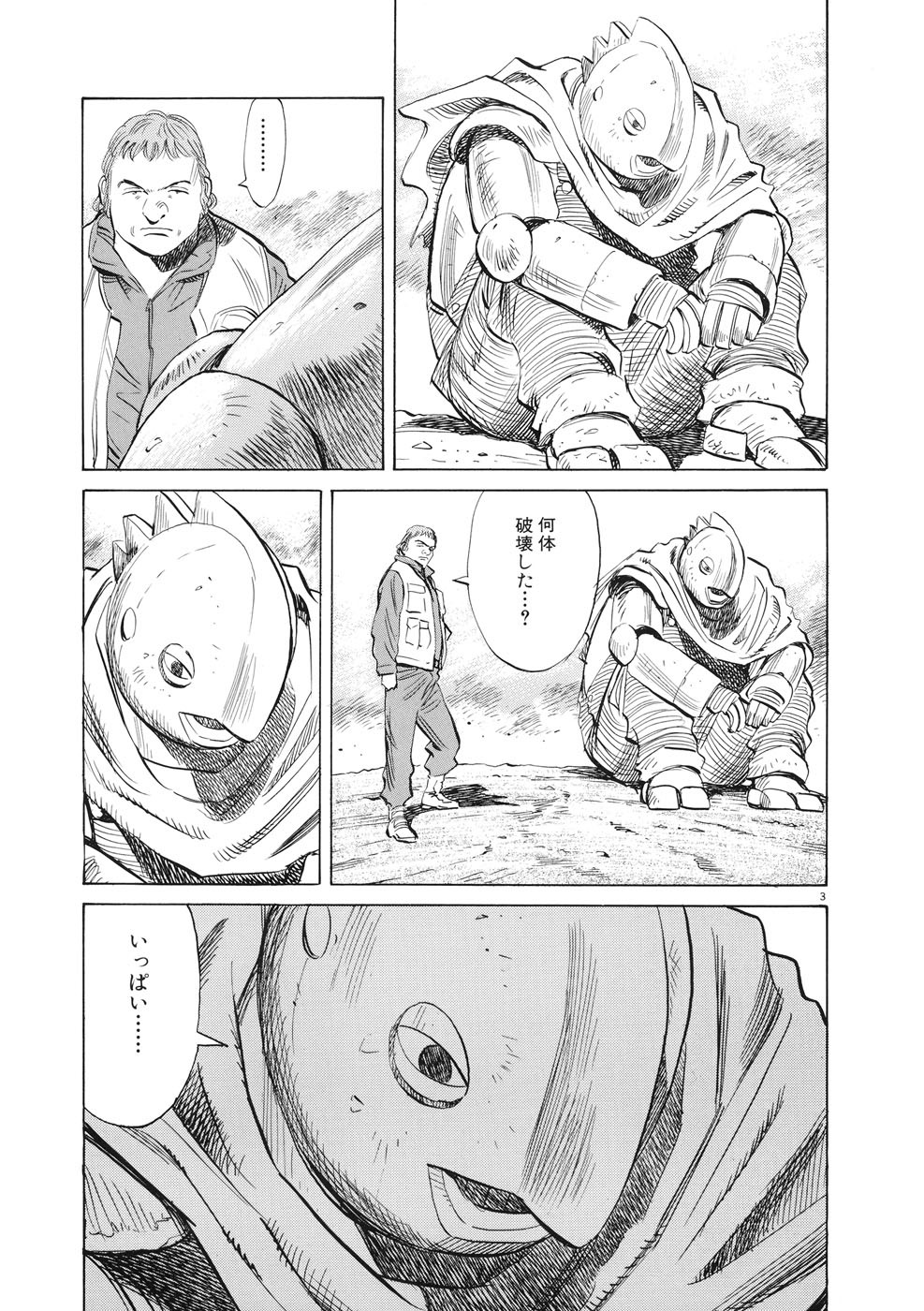
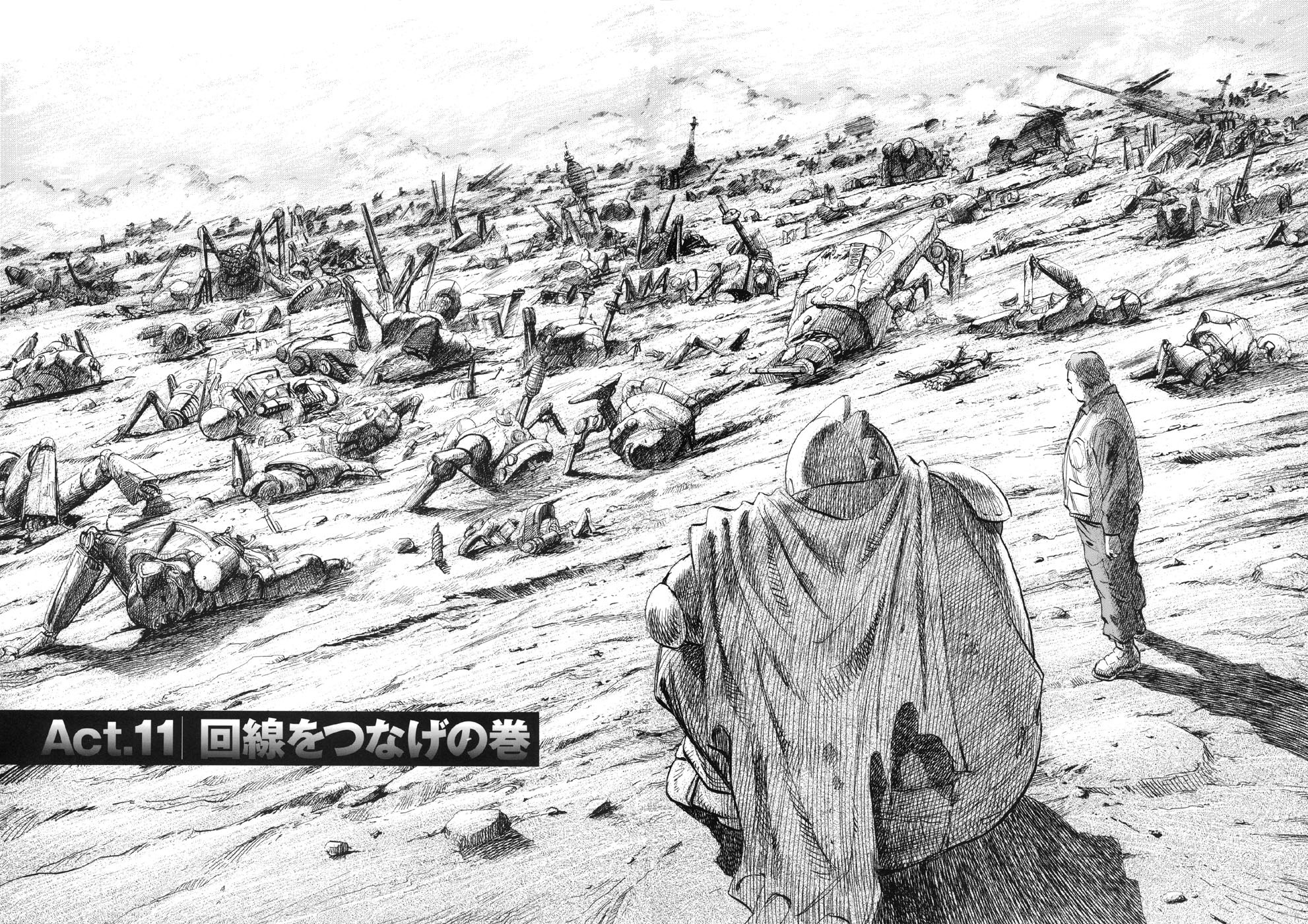
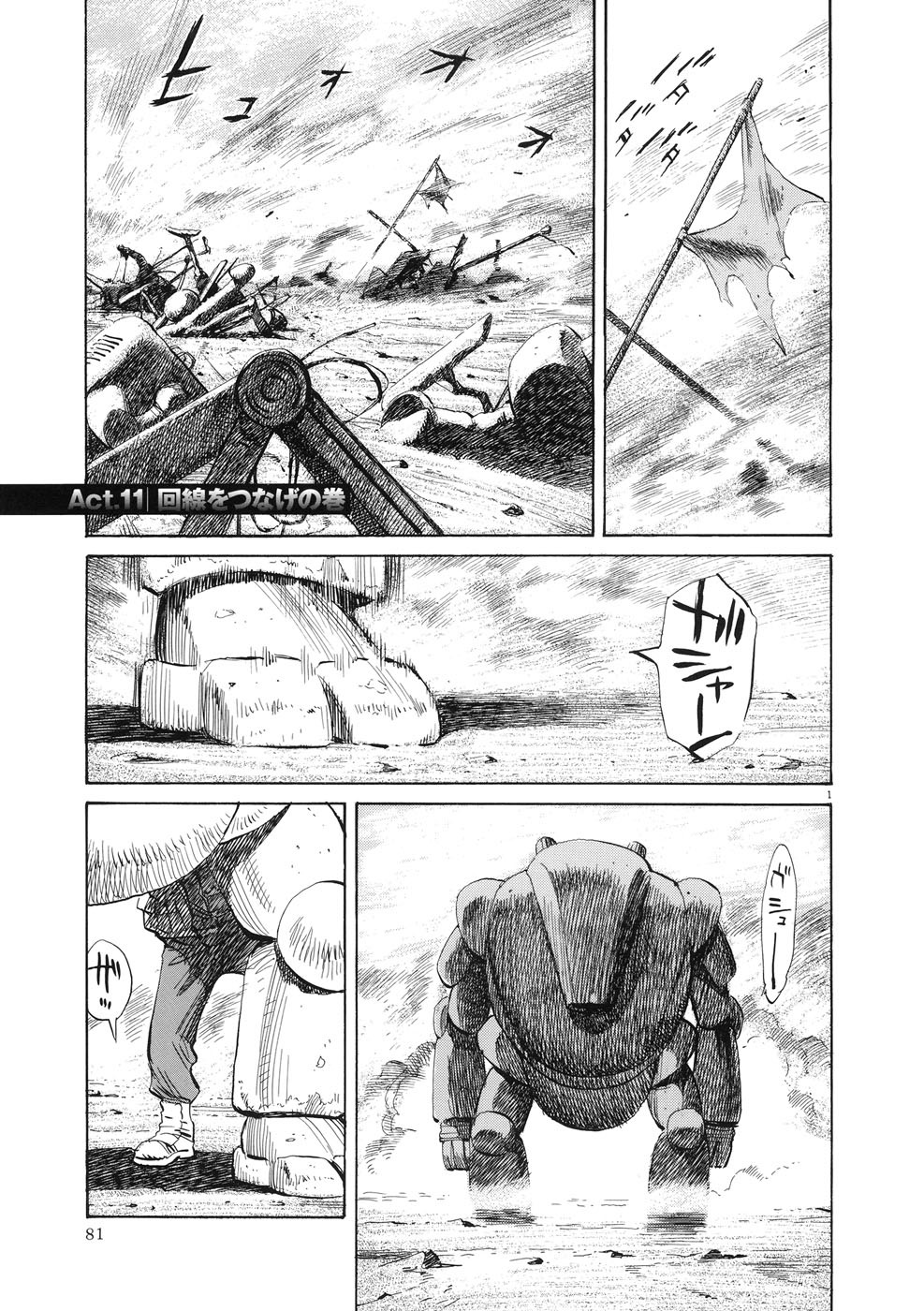
One of the best scenes in the series so far, from an emotional and artistic perspective, involves two of the strongest robots in the world, Brando and Mont Blanc. Urasawa begins the scene with wide shots of bits of wreckage and Brando’s battle suit. Brando himself is a heavyset man who resembles his armor. Urasawa plays with angles and scale in the scene, causing Mont Blanc to seem enormous next to a man who can fairly be called “large.” Mont Blanc stays motionless while Brando approaches, and doesn’t speak when Brando greets him. When Brando asks him how many he killed, there’s a close-up panel of Mont Blanc’s emotionless face, which is followed by a panel that’s even closer while Mont Blanc simply says “A lot.” The next page is a two page spread of devastation. Robots lay dismembered and unrecognizable. No robot is whole in this scene except for Mont Blanc and Brando, and neither are scratched. It was clearly a slaughter.

pluto-war-01pluto-war-02pluto-war-03pluto-war-04

This four page sequence is just a sample of how Urasawa makes Pluto work. There is action, yes, but the real action, the action you care about, is in the drama. It’s in the despair in an emotionless face, and in the way that a robot, a machine built to be precise, simply answers “a lot.” It doesn’t matter how many robots he killed, because the only true answer is “a lot.” He’s fighting in a war, but he’s also struggling with his faith in that war. It doesn’t matter that he killed 3,022 robots. It just matters that he killed a lot. The specifics don’t measure up to the reality.

The follow-up sequence to this examination of war features a televised broadcast of Atom and his role as a member of the peace-keeping forces in this war. The old warhorses (Mont Blanc, Brando, and a third named Hercules) talk about how easy he has it. He’s an “Emissary of Peace.” He isn’t stuck fighting for someone else’s hate, an emotion they don’t even understand. They came to fight for justice, but found something hate in its place. The kind of hate that forces three robots to destroy almost ten thousand of their kin in one day. After Hercules asks “What is this thing they call hate?” they look out over the battlefield and broken robot bodies and the answer is clear.

Even the scenes focused around the serial killing are more about the people involved than the murder. Atom’s encounter with a bigoted detective serves to tell us as much, if not more, about Atom’s character and depth of compassion as it does about the case itself.

It’s hammered home in scene after scene: the characters are what matter. It isn’t about the why, or the what. It’s about the who. The latter third or so of the first volume is dedicated to the story of North No. 2, his new master, and both of their attempts to regain, or attain, their humanity. It’s almost complete lacking in action until the last few pages, and even that action is kept mainly off-screen.

Our first meeting with the killer of the book is played the opposite of the way these scenes usually are done. Rather than a scene which would normally begin with slam-bang action and end in pithy farewells and threats, Urasawa pens a meeting that is disconnected and more than a little sad. Urasawa’s choice for the character who meets the killer first is a keen one in light of that character’s special ability.

The killer, rather than being a thoroughbred monster, is more like a lost animal. He’s confused and detached, not entirely sure of who he is or what he can do. He’s at a different level of humanity than Atom or Gesicht. Gesicht is curious about being human, Atom accepts his humanity, and the killer has lost his, if he ever had it in the first place.

This is where Pluto shines. It’s more than just a murder mystery, and sometimes borders on a subtle meditation on the idea of humanity. Gesicht, Atom, Uran, Brando, Hercules, and the killer are all functioning as different aspects of humanity, and this makes their interactions all the more interesting.

pluto-atomfaces-02pluto-atomfaces-03Urasawa takes an idea that has been run into the ground and manages to pull it off. Every other mature book starring a kids’ character needs to sit up and take notice of how it is actually done. Urasawa doesn’t show us Atom waist-deep in the blood of the fallen to get a rise out of us. There’s no leering, drooling rapist of a villain lurking around in the background to raise the stakes. And despite that, the regret is clear as day on Atom’s face and in the awkward pause after he talks about his role in the 39th Central Asian war.

Where Marvel and DC failed in this is that they went for the cheap shock. A wife of a superhero was raped, a Robin beaten to death, another Robin grew up and became a victim of sexual assault, and if a hero doesn’t die in an event, that event is a failure. They went for the thing that would rile people up, rather than get them talking.

Urasawa gets me talking. I’d barely finished the scene of Atom and Gesicht in the diner before I got online to say something about it. Urasawa has a lot to say in Pluto, and he’s doing it in a way that draws you in without going for the cheap shock of Atom punching through a bad guy.

If you aren’t reading Pluto, you are missing out on some of the best comics around. Volumes 1, 2, and 3 are available now, while 4, 5, and 6 drop in July, September, and November respectively. I assume that Viz is going to keep up a monthly schedule for the series, which means it will conclude in March 2010 with volume 8.
Post to Twitter Post to Delicious Post to Digg Post to Facebook Post to Reddit Post to StumbleUpon

Related posts

h1

Being Broke Is Something I Can’t Afford To Be

May 15th, 2009 Posted by david brothers

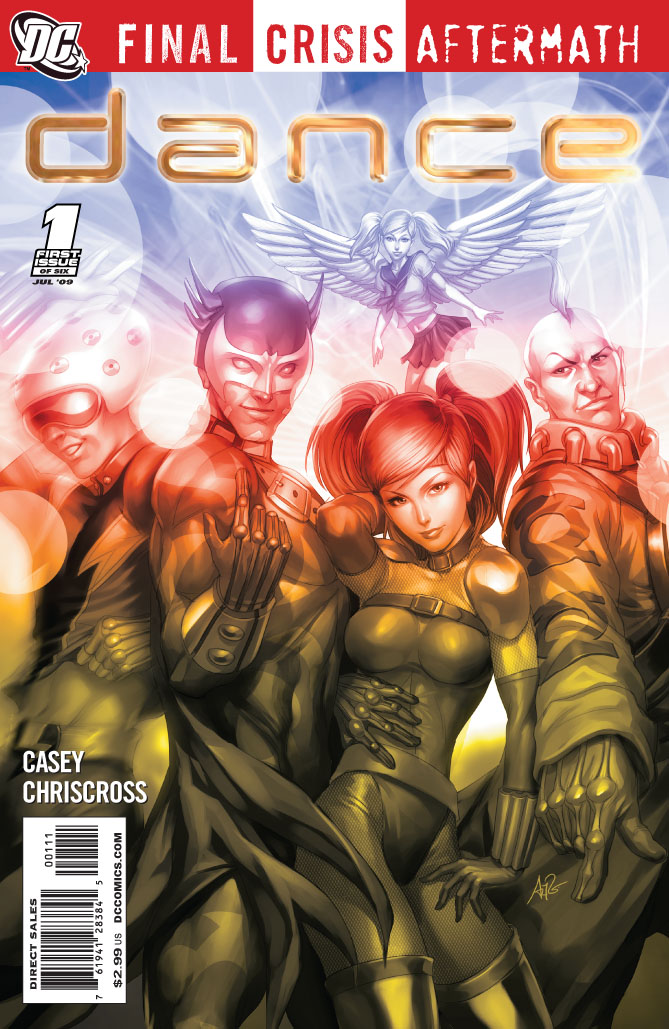
FCAD Cv1DC’s The Source blog put up a preview of the new Joe Casey/Chriscross joint, Final Crisis Aftermath: Dance.

FINAL CRISIS AFTERMATH: DANCE #1
Written by Joe Casey
Art by ChrisCross
Cover by Stanley “Artgerm” Lau
Japan’s Super Young Team wants nothing more than to be seen as heroes in the eyes of their adoring public. Unfortunately, their adventures during FINAL CRISIS have gone unnoticed, and they’ve been reduced to performing at public appearances and on various TV shows literally dancing for their livelihood. But the appearance of a new American teammate and a deadly threat complicates the motives of the team as they try and find what truly makes somebody not just a hero, but a sensational hero. Discover the path to greatness in this exciting 6-issue miniseries!

Even better, Brandon Thomas interviewed Joe Casey about the book and his other work. Casey is off Youngblood, so I’m off that book, too. Plus, he says something I agree with 100% on Obama comics:

JC: No way. That move is so played out. Let the guy be the President now, for chrissakes. I think he’s all through being a cheap marketing ploy, a shortcut to making a quick blast of cash in the Direct Market, don’t you?

Post to Twitter Post to Delicious Post to Digg Post to Facebook Post to Reddit Post to StumbleUpon

Related posts

h1

Welcome to Essex County

May 14th, 2009 Posted by david brothers

I get bombarded with Marvel’s press releases on a daily basis. They vary from on-sale announcements (once a week), interview pimping (a few times a week), and sell-out notices (five in the past seven days). Generally, it’s three or four emails a day. Constant information updates, hype, and pimpery.

Some of it is interesting, I’ll admit– it’s nice to see links to interviews on Marvel.com, since I don’t usually check the main site. However, most of it? The sell-out notices for books that are made on something close to a print-to-order basis? I don’t care. It’s stupid. It isn’t news, because it isn’t even a retailer sell out. It’s at the distribution level, and whoops here comes a second printing next week. It’s a total smoke screen.

I work with a lot of PR in my day job, and I’d like to think that I’ve picked up some things over the past few years. Successful PR campaigns tend to be focused, rather than spread out. There’s a target and you have to hit that target the first time. A constant flood of information only serves to dilute your message and turn your news into anything but.

I got something very interesting in the mail today. Top Shelf Comix is re-releasing Jeff Lemire’s (excellent) Essex County trilogy in softcover and hardcover editions in August. Leigh at Top Shelf sent over a pre-release pamphlet, for lack of a better word. The back cover says that it’s a chapbook that was designed by Carlos Hernandez Fisher. So, chapbook it is.

A Reader's Introduction to Essex CountyA Reader's Introduction to Essex County

It’s a small booklet, about as tall as my hand, with a brown cover. The book is titled “A Reader’s Introduction to Essex County,” and the interiors are just that. There’s an introduction by Leigh Walton that introduces the trilogy, announces the Complete Essex County volumes, and explains the purpose of the booklet.

What follows are preview pages from each book in the trilogy, with praise from critics and creators alike scattered throughout. The previews give you a brief taste of each volume, just enough to give you an idea of the story and the art, but not enough to blow any reveals. It’s a teaser. After the previews are a couple pages of the extra bonus material from the collected edition. A brief bio of Lemire rounds out the book, with the inside back cover being dedicated to a picture by Lemire that says “Now Leaving Essex County.”

A Reader's Introduction to Essex CountyA Reader's Introduction to Essex County

This, to me, is successful PR. It doesn’t get lost in an avalanche of info of varying relevancy and quality. It’s focused on doing one specific thing: reminding you that Jeff Lemire’s award-winning and critically-acclaimed trilogy of Essex County books are getting a deluxe re-issue in three months. It provides order options, details on the format (6.5″x9″, 512 pages, hardcover and softcover), reiterates those details on the back cover, and pulls it all into a neat mini-comic style design.
A Reader's Introduction to Essex CountyA Reader's Introduction to Essex County

It’s attractive, memorable, and different. It’s the sort of thing that helps to build interest in a book, as well as delivering a good amount of info in a tiny package. Even better– I got to the page of one of the books just by clicking one link on the home page from a drop down box. No navigating to Universe/Series/Franchise. Easy.
A Reader's Introduction to Essex CountyA Reader's Introduction to Essex County

Post to Twitter Post to Delicious Post to Digg Post to Facebook Post to Reddit Post to StumbleUpon

Related posts

h1

Compare and Contrast

May 7th, 2009 Posted by Esther Inglis-Arkell

The Battle for the Cowl so far is comprised of three main books, numerous associated mini-series, and a few scattered one-shot tie-ins.  I’m not strongly affected either way by most of these, but this week two of those one-shots loom large in my mind.

The first is an example of the perfect tie-in.  It shows us something we never would have seen if we were following a conventional narrative, and offers us something truly different from the norm while still maintaining the tone of the world for which it was created.  That one was Battle for the Cowl: Arkham Asylum.  Written by David Hine, it takes us on a tour of Arkham Asylum, and for once focuses on the less gruesome aspects of the institution.  Jeremiah Arkham narrates the story, not in the usual hard-boiled tone taken by the Gotham crowd, but with sincere sadness that he hasn’t been able to help the inmates. 

While we sense that he is somewhat unhinged himself, he’s an eccentric and an idealist, not the usual film-noir lunatic.  He finds picks a few inmates who pose no threat, and leads them out of the ruined structure.  In the end, before the final, worrying sting, he expresses the hope that he can rebuild the asylum so that it lives up to its name – so that it can be a true asylum for those who are unable to survive in the conventional world.  It’s refreshing, it’s sobering, and it’s creative.

Sadly, I only really got to thinking about how excellent it was while reading Battle for the Cowl: The Network.  Well, now I know something about myself, at least.  Pissiness is a bigger motivator than honest admiration.

So let’s get to it! 

Well, first thing’s first.  Huntress’s costume has been changed back to a glorified bikini.  And why?  Because the promotional poster for the event, drawn by Tony Daniel, has her back in her Jim Lee costume.  I don’t see why this would necessitate a costume change in the actual book any more than the ’The Real Power In The DCU’ poster would necessitate putting every woman in the DCU in a white evening dress, but I guess that’s how they’re going to play it.

Honestly?  I didn’t even notice the costume change.  A girl fighting crime in a bikini doesn’t catch my eye anymore.  What made me notice was the characters in the story can’t stop picking at the new outfit.  Batgirl, still with a perfect command of the English language, mentions it once.  Oracle mentions it later.  Both talk about how impractical it is.

I don’t know why.  Maybe it’s a jab by writer at a mandated costume change.  Maybe he’s was trying to have his cake and eat it, too, by putting Huntress in a two-piece bathing suit and still snarking about it.  I’m not sure who made the decisions to regress Huntress sartorially. 

I just know that the decision was also made to regress her personally.  When the villain announces that he will start murdering two hostages if the heroes don’t murder one, Huntress pulls her crossbow and is about to take a hostage out when Batgirl knocks her aside.  This is the deal-breaker for me.  Cass is back on the moral high ground, but she had to knock Helena off it to get there.  Never mind that in continuity we haven’t seen Huntress kill in years.  Never mind that we’ve never seen her kill that casually.  In the end, the plot of this book involves the worst mistake a team book can make: cutting off one character at the knees to make another character look good.  That’s never the way to go.

In short: Buy Battle for the Cowl:Arkham Asylum.  Leave Battle for the Cowl: The Network on the shelf.  And stop making women fight in swimwear.

Post to Twitter Post to Delicious Post to Digg Post to Facebook Post to Reddit Post to StumbleUpon

Related posts

h1

Square Story, Round Character

May 4th, 2009 Posted by david brothers

I know that I’m Mister Push Comics Forward Break Them Characters Give Us The New-new, but I do have one continuity-based pet peeve. I really dislike it when creators take established characters and regress them, or just change them entirely, in order to fit them into the story they want to tell.

There are plenty of examples out there. The most egregious are probably Bobby Drake, Iceman, and Johnny Storm, the Human Torch, with Sam Guthrie, Cannonball, bringing up the rear. Bobby and Johnny were the hot-headed youngsters of the X-Men and Fantastic Four, respectively, and Sam is pretty much the poster-child for the second generation of X-Men. All three have gone from immature, mistake-making, and newbie heroes into grown-up, mature, and seasoned adults.

Bobby is an Omega-level mutant with an insane amount of control over ice, and therefore water, and has come to terms with that. Johnny has wielded the Power Cosmic a couple of times, saved the world several dozen times, and seen planets, dimensions, and time periods other people don’t even dream about. Sam was trained by the son of the X-Men’s best strategist, who was himself a child of war. He also had the benefit of being trained by two generations of X-Men, and when he struck out on his own, he found success.

The problem is that when a writer has a story that needs an impetuous kind of fella, or a newbie to make a dumb decision, or someone to show just how mature or smart another character is… guess which dudes are the fall guys.

Reed Richards has gone through the “ignoring his family for the benefit of science by the way he is a jerk” cycle a fistful of times now, most recently in Mark Millar’s Civil War. You’d think that Cyclops’s turn as the depressed and distant loner would be over after New X-Men, a story designed to push him past that, would never happen again. Or that Beast Boy, who is like thirty years old and should get a new name, would be written as something other than a horny teenager. Nah.

This is something that’s been bugging me more than usual lately, since the three biggest guys in comics have all been doing it. Mark Millar, Brian Bendis, and Geoff Johns have all taken characters who had established personalities or gimmicks, tossed it out, and slotted something new in because they needed X so that they could write Y. Rather than creating X, they just took Z and turned it into X. And that’s lame.

I brought visual aids. Read the rest of this entry �

Post to Twitter Post to Delicious Post to Digg Post to Facebook Post to Reddit Post to StumbleUpon

Related posts

h1

Grim And Gritty Isn’t The Problem

April 20th, 2009 Posted by Esther Inglis-Arkell

I was recently going over David’s post about DKSA, and his point about how it exorcised some of the grimness and misery that DKR introduced into superhero comics.  While I think that he makes a good point, and one echoed by Miller himself, when he described that in DKSA he was comparing superheroes to the pantheon of Greek gods - with their failings, their enthusiasms, and their various eccentricities.

However, I have to disagree with David.  Not because I don’t think he has correctly interpreted the way DKSA changes the tropes set up in DKR, but because my difficulties with Miller’s Batman aren’t really about his grimness.

David concludes his essay with this:

Where we’ve had paranoid and grim Batman for the past fifteen years, Miller gives us one who’s faking grim but skipping like a schoolboy on the inside. Where we’ve had an utterly miserable Batman who figures out ways to trap his friends, Miller delivers a Batman who believes in the strength of others and trusts his fellow warriors.

DKSA is an exorcism. It takes all of the grim and gritty from DKR and the ensuing years and turns it on its head. It’s a push toward day-glo superheroics and away from miserable heroes. The moral of DKSA is “Superheroes are cool!”

My problem with Miller’s legacy isn’t, primarily, the grimness and misery.  That may sound strange, considering I’ve written essay after essay about my love for the lighter side of comics, and my desire for more comics to embrace fun and imagination over dark storylines.  However, it’s not the misery itself I object to, but the balance between light and dark.  I enjoy some angsty melodrama and some brutal violence as much as the next gal, I just feel like modern comics is stuffing me full of pretzels and not offering me any water, if you know what I mean.  I few more light-hearted stories, comics, or comic lines would be refreshing.

However, it’s not Batman being a miserable and paranoid that bothers me when I’m reading DKR.  It’s Batman being, how shall I put this?  A double-barrelled bastard.  Yes.  I believe that’s the technical term.  Read the rest of this entry �

Post to Twitter Post to Delicious Post to Digg Post to Facebook Post to Reddit Post to StumbleUpon

Related posts

h1

Newsarama’s Interview With Dan Didio

April 17th, 2009 Posted by Esther Inglis-Arkell

In this interview, Matt Brady asks Dan Didio about, among other things, Jason Todd’s recent killing spree.  Didio responds with this:

Let’s take this one from the very beginning. When a story is going to be told where we feel that a character crosses a moral line, we just don’t put that in arbitrarily. We think through how that affects everyone around him, and what the long-term ramifications of that action will be.

The perfect example of that was when Wonder Woman killed Max Lord. We thought that all the way through – we saw how that affected the relationship between Superman, Batman, and Wonder Woman. We saw what happens when that relationship breaks down, and how that affected the entire DC Universe, as well as how it was ultimately resolved. We saw those causes and effects all the way through. Or another case – Identity Crisis – we saw those events, the effects of those events, and how they played through the DC Universe. Every time that we try to do a major story where we feel a moral line has been crossed, there are always ramifications because of it. Things that you’re mentioning with Jason – of seeing him kill – are all potential stories for the future. Unless he doesn’t make it out of Battle for the Cowl, these are all story beats that we’d like to see play out throughout the DCU, and they’re all fodder for future storytelling.

Although I can see the point that he is trying to make, and although I recently wrote about this very issue as it pertains to Jason Todd, Didio’s response rings false to me.

In the first place, can’t any development become a set up for future stories?  If Jason Todd were to unexpectedly come into his own and become the hero of Gotham City, wouldn’t that be a good set-up for future stories?  It could be a call-back to the earliest version of Batman, a man who carried a gun and who regularly killed criminals while still being a respected hero.  If Jason Todd were, instead, to be captured, it would also be a set-up for future stories.  The Batfamily would have to band together to get him out.  If Jason Todd were turned into a frog, it would be a set-up for future stories.  (Best.  Zatanna story.  Ever.)  Since this justification can be given for any story at all, it becomes meaningless.  It doesn’t matter that an action can cause interesting events in the future if there is no reason for that action happening now.

Secondly, Gotham has been rather heavy on set-up lately, while being light on story.  Remember War Games?  It was a multi-title, multi-month event that set up Black Mask as the ruler of the city.  Then he didn’t do much.  Then he was killed.  Now he’s back.  And he’ll have, I suppose, a lot of competition for supremacy, since Face The Face was a long story that set up White Shark as the crime boss of Gotham City.  Where has he been lately?  Maybe he was bumped off by whoever it was who came out on top in Gotham Underground.  The name escapes me, since I’m pretty sure there have been no stories told about them, either.  Or maybe he’ll fight the Al Ghul family, headed by Ras, Nissa, Talia, Ras, Talia?  It’s not that DC hasn’t published some great ongoing stories.  It’s just that I’ve been hearing a lot about a set-up for future stories and comparatively little about the stories themselves.

Finally, there is Didio’s line, “Unless he doesn’t make it out of Battle for the Cowl, these are all story beats that we’d like to see play out throughout the DCU.”  Didio has a tongue-in-cheek interview style that doesn’t always come through in writing, so perhaps he’s making a joke.  If he isn’t, the entire paragraph falls down.

I don’t want to descend into angry fanism, but I’m growing a bit tired of hearing that no decision is arbitrary, that there haven’t been any mistakes in characterization, that there will be a justification for a certain character’s actions in a year, another book, an unannounced-and-unplanned-yet-possible storyline.  There should be a reason why a character acts a certain way.  That reason should have something to do with the character’s actions, attitudes, or immediate wants.  “We can write about it later,” is not that reason.

Post to Twitter Post to Delicious Post to Digg Post to Facebook Post to Reddit Post to StumbleUpon

Related posts